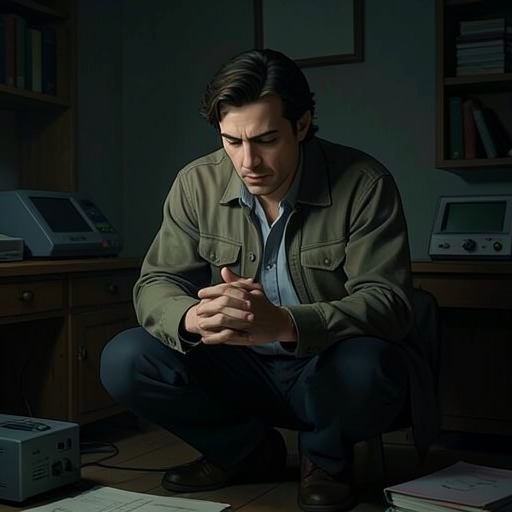
Police Break the Protagonist's Hand
The RoomThe Police Break the Protagonist's Hand is a formative episode of police violence remembered by the Unnamed protagonist during his imprisonment. A police officer strikes him across the hand while he is reaching for dice in a park; the pain is delayed, the injury is hidden from his parents, and an X-ray the next morning reveals three clean breaks. The memory returns not as a resolved account of justice, but as a source of grievance that feeds the protagonist's fantasies of revenge and his broader distrust of police power.
Circumstances of the Assault
The Unnamed protagonist is twelve or thirteen, playing dice with two friends beneath a light in a park on a cool evening. The boys are absorbed in the game and in keeping their hands warm. Two cents lie on the ground, and he is reaching for them when someone calls out that a police officer is there. As he bends to grab the money, an officer emerges from bushes behind him and strikes his reaching hand with a club.
The officer does not pursue the boys, and the protagonist never learns what he looks like. He runs without feeling the injury at first. A block away, he meets his friends; they walk the remaining few blocks home together. They ask about his hand, and he tells them it is all right, although it is beginning to burn. The sudden blow and the officer's disappearance leave the episode without an identified assailant or an immediate confrontation: the protagonist carries the injury away, but not the officer's face.
Injury and Concealment
At home, the warmth makes the pain worse. The protagonist is afraid to tell his parents what happened because he expects them to ask why he was hit, and he is also afraid to admit what he and his friends had been doing. In the middle of the night, the pain becomes acute; he moans in his sleep, waking his mother. He tells her that he fell while playing a game and hurt his hand, substituting a safer explanation for the assault.
The next morning, his mother takes him to a hospital, where an X-ray shows three sharply broken bones. The breaks are so clean that they show no splintering, despite the force of the blow. The injury does not need to be set or placed in a cast: a small roll of gauze is put in his palm and the hand is wrapped. The medical simplicity of that treatment contrasts with the violence that produced the injury. The episode establishes both a concrete bodily consequence and the protagonist's early decision to conceal its cause from his family.
The Memory in Prison
The assault reappears in the protagonist's prison thoughts as he paces repeatedly between the wall and the door, counting his steps and trying to keep them identical. The rigid counting turns into a stream of anger. He imagines fixing matters when he gets out, getting the officer who broke his hand removed from the force, and eventually taking revenge with the officer's own club. He also directs his rage at two other men, but the remembered strike itself was delivered by one officer, whose identity remains unknown to him.
This imagined retaliation is not an account of what happened after the childhood injury; it is what imprisonment makes the memory do in the present. The protagonist moves from a precise recollection of the club hitting his hand to a future-tense promise of punishment. The memory offers an object for his rage, but no verified route to identifying or holding the assailant accountable. The distinction between the known event and the imagined reckoning remains important: the assault is recalled as fact, while revenge is still a fantasy.
Police Power and Recurring Resentment
Elsewhere, the protagonist develops a sweeping argument that obscure laws give police tools to harass citizens, and that officers may use authority to avenge real or imagined grievances. The childhood assault supplies a personal history for that conviction: a boy reaching for two cents is struck by an officer, then goes home hiding why his hand hurts. The memory supports the protagonist's sense that ordinary vulnerability can meet force without explanation, although his general claims about police and law remain his own assertions rather than findings established by this incident.
The injury also resurfaces when he thinks of a separate episode involving a woman shot by a child. He recalls the police searching the neighborhood and handling the boy's toy shotgun and cap pistol, then turns back to the officer who broke his hand and wishes he had taken the man's club. That association places the childhood blow within a wider, unsettled store of anger about policing; it does not establish a connection between the two events. In a later prison outburst, the protagonist likewise describes the justice system as rigged against people without money and resents the unequal treatment of poor defendants. Together, these recollections show how the hand injury becomes more than an isolated childhood wound in his telling: it is a recurring point of reference for his distrust of authority, his sense of being wronged, and his imagined payback. The account supplies no later identification of the officer, investigation, or remedy.